

Operating laser cutting machines involves critical safety risks that demand meticulous management. High-power lasers can inflict severe injuries, including third-degree burns and permanent eye damage, if stringent safety protocols are not rigorously enforced. The laser's intense focal point, often exceeding 2000°C, can rapidly ignite flammable materials, presenting significant fire hazards. To mitigate these risks, comprehensive safety measures are imperative:
- Protective equipment: Operators must wear appropriate laser safety eyewear with an optical density (OD) matched to the specific laser wavelength and power.
- Machine enclosures: Fully enclosed Class 1 laser systems with interlocked safety doors and viewing windows with proper filtering.
- Emergency systems: Readily accessible emergency stop buttons and automated fire suppression systems.
- Training: Rigorous operator training on laser physics, potential hazards, and proper machine operation, including ANSI Z136 standards compliance.
Health Hazards
The laser cutting process generates potentially hazardous fumes and particulates, especially when processing engineered materials. These emissions can pose significant health risks if not properly managed:
- Metal fumes: Cutting stainless steel or galvanized materials can release hexavalent chromium or zinc oxide fumes, known carcinogens and respiratory irritants.
- Polymer decomposition: Cutting plastics like PVC can produce hydrogen chloride gas and other toxic substances.
- Nanoparticles: High-power lasers can generate ultrafine particles that can penetrate deep into the lungs.
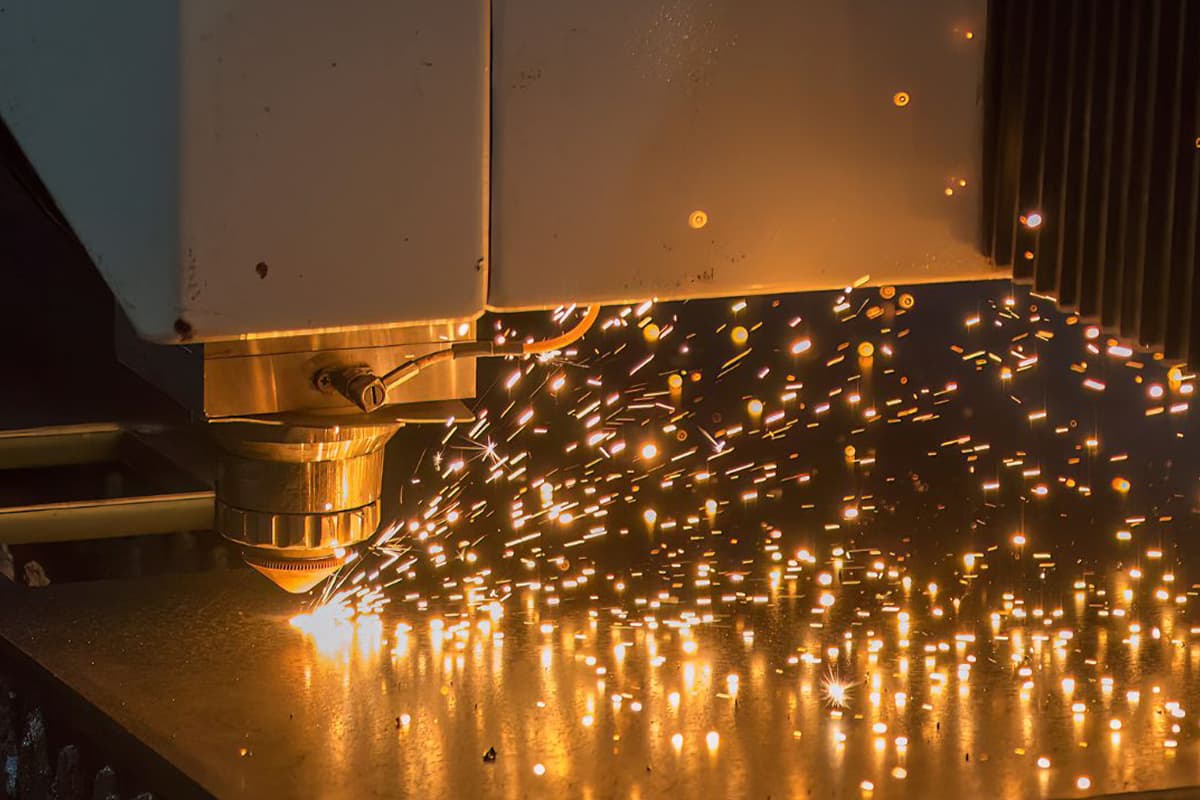
To safeguard worker health:
- Implement high-efficiency fume extraction systems with HEPA filtration (minimum 99.97% efficiency for particles ≥0.3 μm).
- Utilize source capture methods, positioning extraction nozzles as close to the cutting zone as possible.
- Provide workers with appropriate personal protective equipment (PPE), including respirators rated for specific contaminants.
- Conduct regular air quality monitoring, including particle counting and gas analysis, to ensure compliance with OSHA PELs (Permissible Exposure Limits).
- Implement medical surveillance programs for workers regularly exposed to laser cutting fumes.
Environmental Considerations
The environmental impact of laser cutting extends beyond immediate health concerns:
Energy consumption: High-power CO2 lasers can consume 10-30 kW during operation. Fiber lasers offer improved efficiency but still contribute significantly to energy usage.
Waste management:
- Metal scrap: While recyclable, requires proper sorting and handling.
- Spent filters: May contain hazardous materials and require specialized disposal.
- Assist gases: Nitrogen and oxygen cylinders must be properly managed and recycled.
- Water usage: Water-cooled lasers can consume significant amounts of water, impacting local resources.
To minimize environmental impact:
- Implement energy-efficient laser systems and optimize cutting parameters to reduce power consumption.
- Utilize nesting software to maximize material utilization and minimize scrap.
- Establish closed-loop recycling programs for metal waste and assist gas cylinders.
- Consider transitioning to fiber lasers, which typically offer 2-3 times higher energy efficiency than CO2 lasers.
- Explore dry cooling systems or closed-loop water recycling for cooling systems.
- Conduct regular environmental audits and strive for ISO 14001 certification for environmental management systems.
2D Cutting Limitations
Laser cutting technology primarily excels in 2D applications, offering unparalleled precision for flat sheet material processing. However, its limitations become apparent when confronted with complex 3D geometries or intricate spatial structures.
While 2.5D cutting (multi-level flat cutting) is achievable, true 3D capabilities remain elusive for conventional laser systems. This constraint can be particularly challenging in industries like aerospace or automotive manufacturing, where complex three-dimensional components are essential.
To overcome this limitation, manufacturers often integrate laser cutting into hybrid manufacturing cells, combining it with complementary technologies such as 5-axis CNC machining or additive manufacturing. This synergistic approach allows for the creation of complex 3D parts by leveraging the strengths of each process.
Thermal Effects
The high-energy density of laser beams introduces significant thermal considerations during cutting operations. Material-specific heat-affected zones (HAZ) can lead to microstructural changes, residual stresses, and potential defects such as warping, edge melting, or discoloration.
The severity of these thermal effects is influenced by factors including laser power density, pulse characteristics, cutting speed, and the material's thermophysical properties. Mitigating these effects requires a nuanced approach to process parameter optimization.
Advanced techniques like adaptive optics for beam shaping, synchronized pulsing strategies, and localized cryogenic cooling can significantly reduce thermal damage. Additionally, post-processing treatments such as stress relief annealing may be necessary for critical components to ensure dimensional stability and mechanical integrity.
Cooling Requirements
Effective thermal management is crucial for maintaining both cut quality and equipment longevity in laser cutting systems. Cooling requirements extend beyond the workpiece to encompass the laser source, optics, and auxiliary components.
Modern high-power fiber lasers often employ multi-stage cooling systems, integrating water-cooled chillers for the laser diodes and resonator, alongside forced-air cooling for beam delivery optics.
The cutting head itself may utilize a combination of water cooling for the focusing optics and assist gas for nozzle cooling and molten material ejection. Implementing closed-loop temperature control systems with real-time monitoring allows for dynamic adjustment of cooling parameters, optimizing energy efficiency while ensuring consistent cutting performance.
For particularly heat-sensitive materials or high-precision applications, advanced techniques such as cryogenic assist gas or pulsed cryogenic jet systems can be employed to further mitigate thermal effects and enhance cut quality.
VI. Alternatives and Considerations
Other Cutting Technologies
While laser cutting is widely used, other cutting technologies may better suit specific needs.
Waterjet cutting uses a high-pressure stream of water mixed with abrasives to cut through various materials, especially thick, reflective, or heat-sensitive ones. It avoids thermal distortion and can handle metals, stone, and ceramics.
Plasma cutting employs a high-velocity jet of ionized gas to melt and cut conductive metals. It is fast and efficient for cutting thick metals, often used in construction and metal fabrication, though it lacks the precision of laser cutting.
Choosing the Right Technology
Choosing the right cutting technology depends on material type and thickness, required precision, budget, and project needs. Laser cutting is ideal for high precision and fine details, while waterjet or plasma cutting is better for thicker or heat-sensitive materials.
Consider total costs, including setup, energy, maintenance, and operation, to make an informed decision that aligns with production goals and budget.